


Career Growth Framework for Managers: How to Define and Develop Employees (PSHE Model)
Learn how the PSHE framework helps managers define job levels, evaluate performance, and create clearer, more consistent career growth paths.Managers and People leaders constantly face the question: "What does it mean to operate at the next level?" Despite the best intentions, conversations about performance and promotion often feel subjective or inconsistent, leaving both sides of the table without a clear path forward.
The Problem, Solution, How, Execute (PSHE) framework provides a practical, scalable model to guide those discussions, giving managers and People leaders a shared language for defining job levels, calibrating performance expectations, and making career development conversations more objective and actionable.
What the PSHE Framework Represents
Problem, Solution, How, Execute are the four components that define ownership in any role. The model explains how responsibility evolves as someone grows in their career.
As employees move up in levels, they take ownership of more stages in that cycle: from simply executing on assigned work to independently identifying and solving complex, cross-functional challenges.
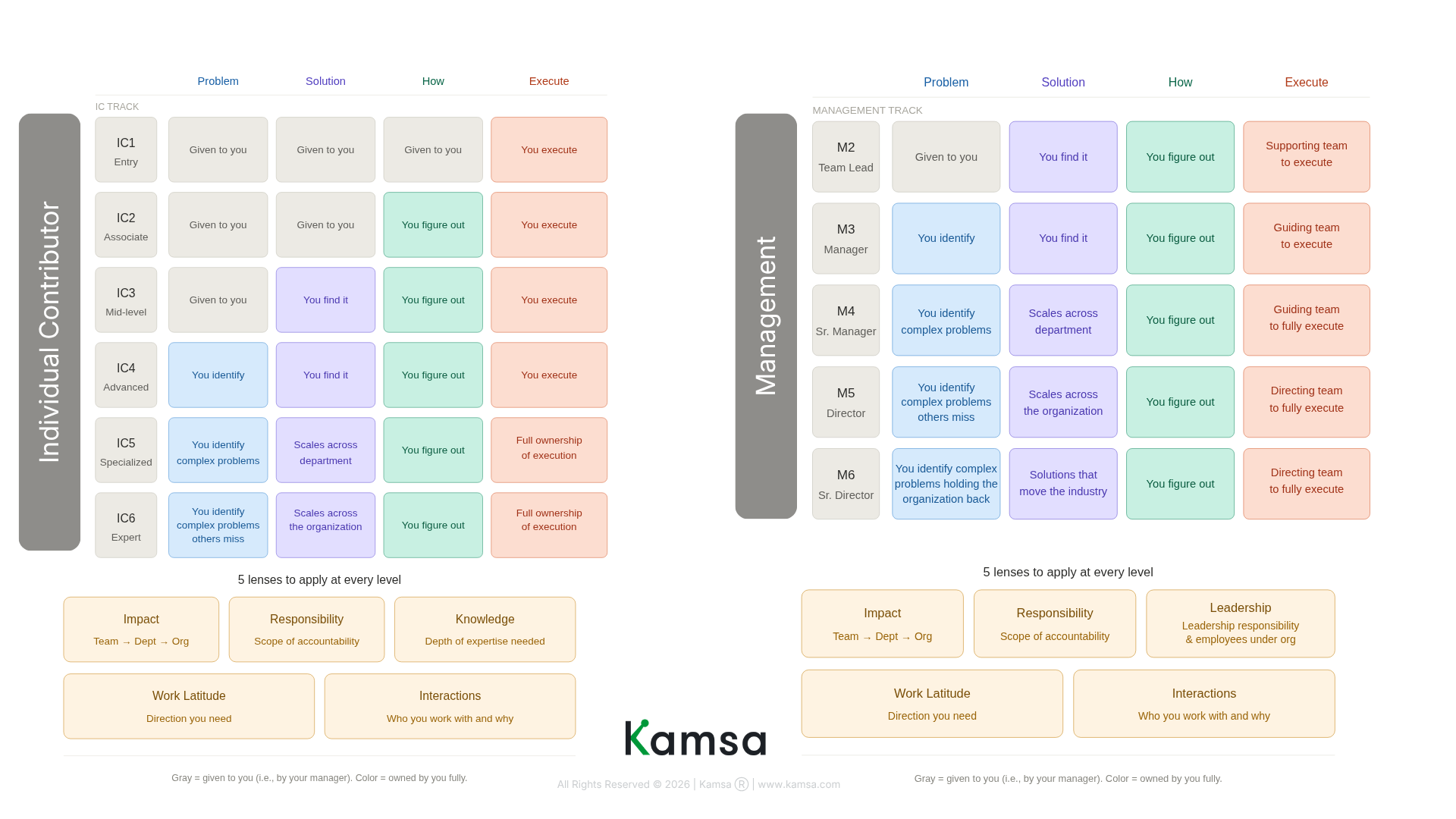
This progression shows gray areas (elements provided by a manager) gradually transforming into color (elements owned by the individual). Growth is not just about performing current tasks better. It's about owning more of the process end-to-end.
The Five Lenses for Evaluating Levels
Complementing the PSHE stages are five key assessment lenses that help organizations define and calibrate expectations within each job level. These lenses allow managers and People leaders to evaluate growth with consistency and reduce the subjectivity that often creeps into performance management.
1. Impact
Who and what is affected by this person's decisions?
- Early-career employees create impact within their immediate team.
- Mid-level professionals influence multiple projects or functions within a department.
- Senior and specialized roles shape strategic outcomes at the departmental or organizational level.
This lens helps managers recognize when an employee's influence has genuinely expanded and ensure that growth gets acknowledged at the right time.
2. Responsibility
What is the scope of ownership and accountability?
- Associates focus on completing assigned deliverables.
- Mid-level employees own full projects or workstreams.
- Senior employees navigate complex, ambiguous contexts, balancing competing priorities and interdependencies.
Managers can use this lens to set clear expectations, prevent scope creep, and keep development plans tied to measurable, role-based outcomes.
3. Knowledge
How deep and broad is the expertise required at this level?
- Early roles rely on technical or procedural proficiency.
- Mid-level professionals combine technical depth with cross-functional understanding.
- Senior employees develop system-level thinking, connecting expertise across business, strategy, and execution.
This lens is particularly useful for identifying the right growth investment, whether that means deepening a specialization or expanding across disciplines.
4. Work Latitude
How much direction or oversight does this person need to do their job well?
- At early levels, work is guided by a manager's direction and feedback.
- As individuals mature, they make independent decisions within aligned goals.
- At senior levels, they set direction, anticipate challenges, and guide others to deliver at scale.
This is one of the most critical lenses for promotion conversations. It draws a clear line between strong execution and true next-level ownership.
5. Interactions
Who does this person work with, and what's the nature of that influence?
- Early roles inform peers or managers about progress.
- Mid-level roles collaborate across teams and influence peers.
- Senior roles engage leaders, executives, and stakeholders, shaping decisions and driving alignment.
By looking at interactions, managers can assess when someone is ready for greater visibility, cross-functional responsibility, or leadership exposure.
Applying PSHE in Management
The PSHE framework integrates naturally into the core practices of talent and performance management. Here are four practical ways managers and People leaders put it to work:
- Performance Reviews: Anchor assessments around the five lenses to ensure evaluations are fair and based on observable behaviors. This kind of structure reduces bias and builds trust in the review process across the organization.
- Career Pathing: Use the framework during career development conversations to make expectations concrete. Instead of abstract traits like "show more leadership" or "think more strategically," PSHE gives you specific, actionable language such as "Start identifying problems before they're raised" or "Propose solutions, not just issues."
- Promotion Decisions: Use PSHE as a calibration tool during promotion discussions. It gives managers and employees concrete examples to reference, including increased responsibility, expanded impact, and reduced need for oversight, rather than relying on gut instinct or tenure.
- Defining New or Evolving Roles: When building new positions or restructuring teams, map each PSHE stage and the five lenses to define the right level of ownership and scope from day one. This keeps job descriptions grounded in real business need and prevents overlap or confusion between roles.
When managers and People leaders work from the same framework, career conversations become more objective, easier to document, and far less likely to feel personal or arbitrary.
A Shared Language for Talent Development
The PSHE framework and its five lenses give organizations a unified way to define, discuss, and develop talent at every level. For managers, it brings structure and consistency to some of the hardest conversations in leadership, including performance calibration, promotion readiness, and role clarity.
By building a common language around ownership and scope, teams can foster stronger engagement, more transparent career development, and a workplace culture where growth is visible, fair, and achievable.


